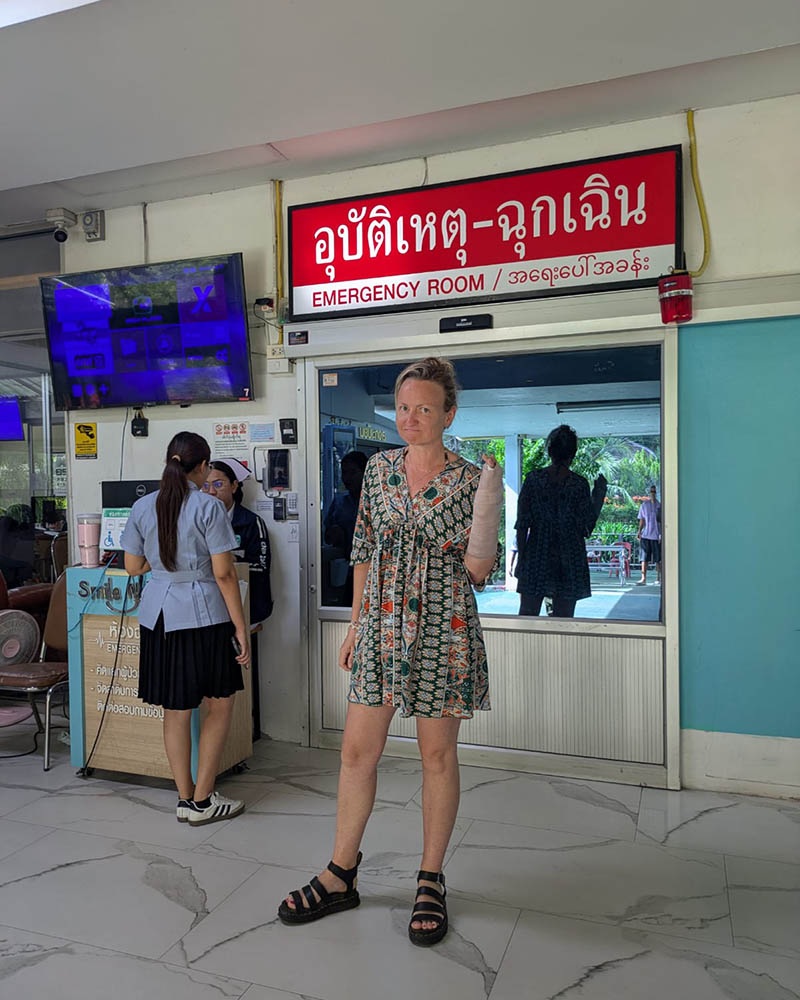
During our family holiday on the island of Koh Phangan in Thailand, I had to make a stop at the Accident & Emergency department with a swollen and sore hand. On the X-ray, the problem was clear. One of the bones in my palm looked like a splintered piece of wood. A fracture of the metacarpal. It had taken me two days to come to the hospital. At first, I shrugged it off as a sprain. I took take some Ibuprofen and went for a long swim in the sea. However, the pain and swelling did not ease.
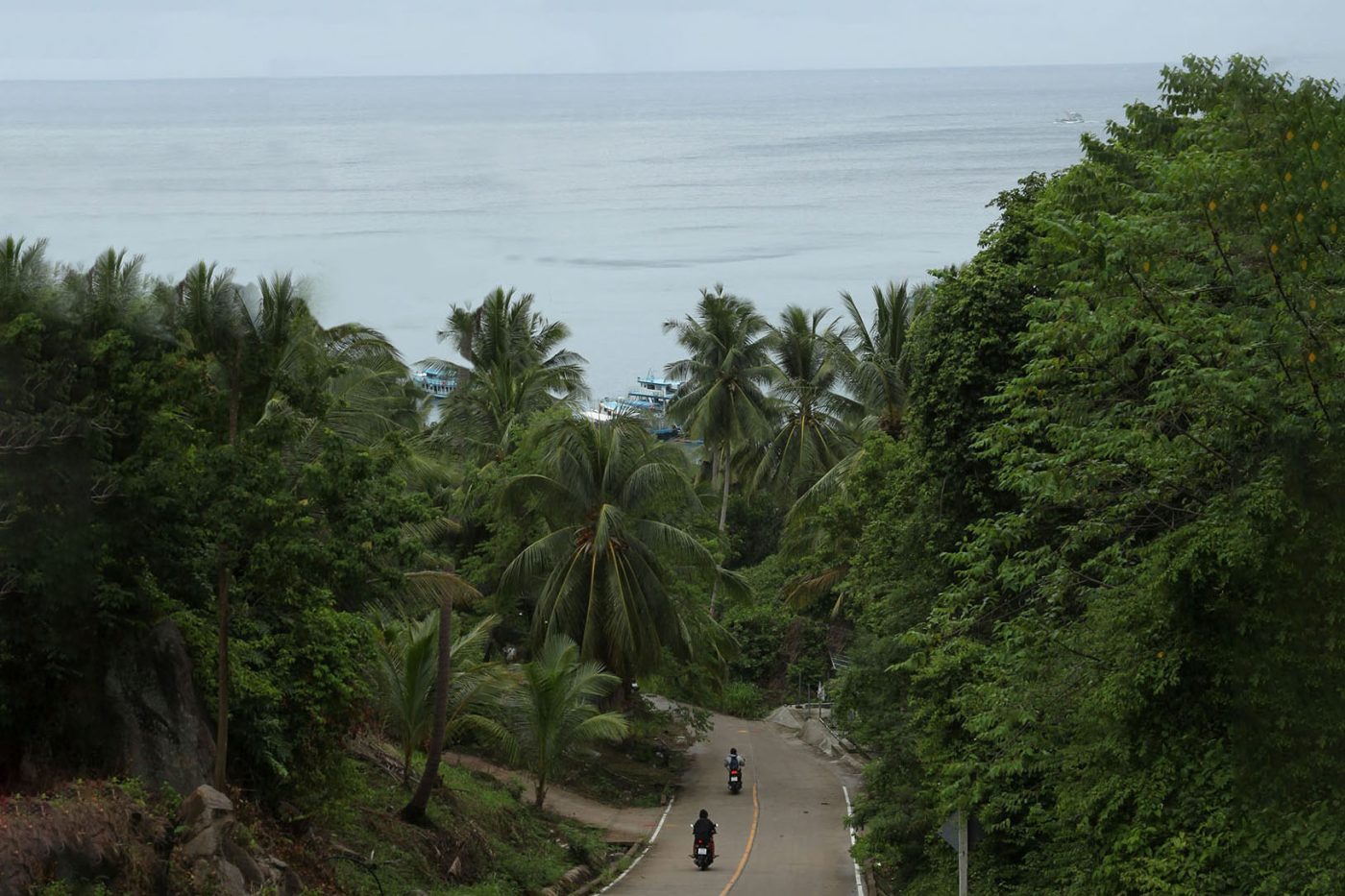
“Motorbike?” the nurse asked when, on arrival, I showed him my wonky, puffy index finger. I nodded sheepishly. It was a fair assumption. Renting a motorbike is the most popular and flexible way to explore Koh Phangan, with standard 125cc automatic scooters costing around four or five pounds per day. Daily minor and major crashes occur constantly, and I was one of them.
We can control our breathing
In the clinical trauma room, the only other patient was a dishevelled and bewildered western man, aged around forty-five, lying opposite me with a bleeding gash on his leg from – you’ve guessed it – falling off his motorbike. I watched a caring nurse pour disinfectant onto the man’s wound and I flinched as he bellowed and roared, putting his knuckles in his mouth and biting down. He was fighting against the burn. I had a compulsion to go to the man’s bedside and encourage him to slow down and consciously breathe. It hadn’t occurred to him that he could.
Cold water immersion has taught me that the more we battle against discomfort, the worse it feels. (I also known from three rounds of childbirth.) In my job as a cold water therapist, I explain the perils of resistance to the clients I work with in the ice bath. “If you fight this, it’ll be difficult,” I tell them. “If you surrender, you’ll be fine.” I leave them with two words. “Just breathe.” Our breathing is, after all, the one bodily function we can control.
It comes down to the life lesson of accepting we cannot control the events around us but we can control ourselves. We dictate our reaction to things. The mind and body are linked. We are one. A whole. The man on the hospital bed was not a whole. He was a fragmented mess. Although he couldn’t connect with steady, conscious breathing I certainly could, and so I used slow, deep belly breaths to stay calm amongst the chaos. “You’re OK,” I told my body. That’s the thing – our nervous system believes the story we tell it. Reassure it. Tell it everything will be alright, and it likely will.
Often, we have more than enough
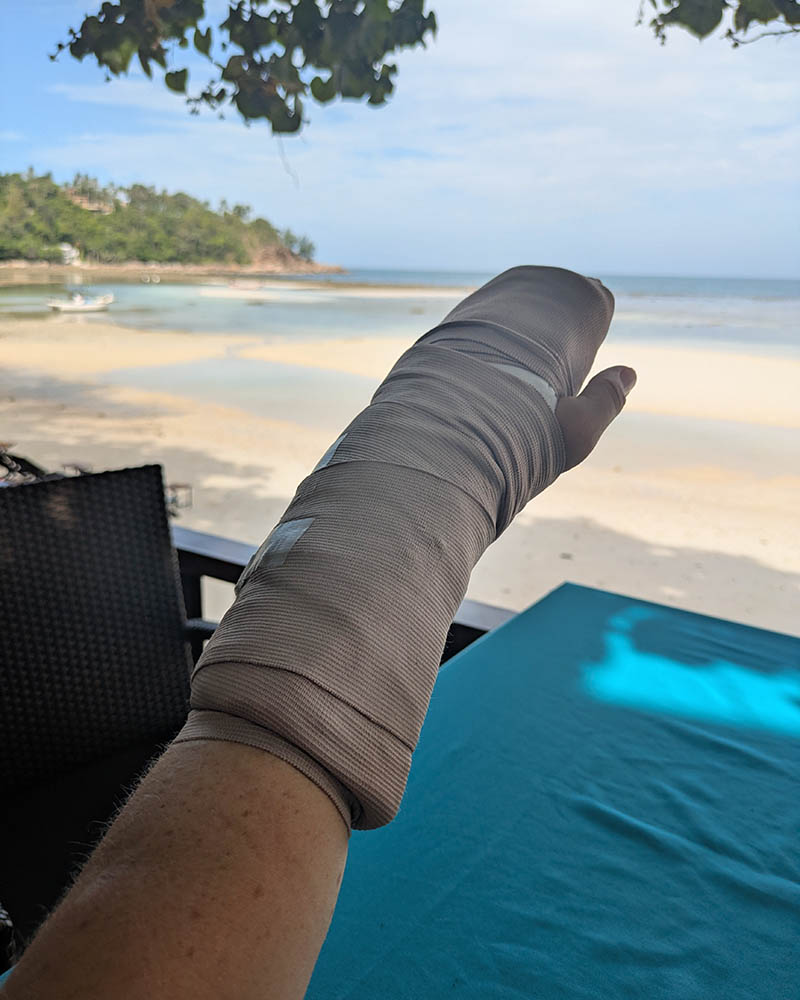
I left the hospital wearing a cast which immobilised my entire left hand and reached halfway to my elbow. It was heavy, cumbersome and ugly. The first panicked thought was, “How will I swim?” I lamented my lost lengths in the pool and my dives into the sea but, once again, the lesson of letting go of what I could not control applied. I focused on what I could control – that is, my response to my circumstances. I looked at what I did have, and what I could still do. I therefore chose to be grateful.
I’m right handed, and so I could still brush my teeth. Write with a pen. Press the button on a camera (although twisting the lens was tricky.) Shovel rice with a spoon. I still had arms to hug my children. Legs to walk on the beach. I had ears to hear cicadas rubbing their wings. A nose to smell Frangipani flowers dripping from the trees. Eyes to marvel at the streaky sunset. A mouth to speak, and to taste spicy coconut soup. I bought a waterproof cast protector and I did lengths in the pool and snorkelled at the nearby Ang Thong National Marine Park. Unfortunately, I couldn’t swim front crawl. The arm was too heavy and actually, it would have been detrimental to the bone trying to heal. Still, what I could do was enough, and I had to remind myself of that.
That’s the thing about human beings – we always want more. There are occasions where it is right to want more, to expect more, but there are also times to appreciate what we already have, to recognise that we have enough. There are days when I certainly struggle with this and when I do, I write things down. I do my gratitude list. With this comes peace and presence.
I fear people’s judgement
I’ve worked hard on not caring what others think about me and my life choices but as I sat in the hospital, I found myself fretting about just that. A mother-of-three careering around bends on a motorbike, I’d been reckless and irresponsible…hadn’t I? My injury was self-inflicted and deserved? Did I believe that? Whose voice was that? It certainly wasn’t mine! I found myself deliberating on what to tell friends and family back home. Shall I say that I tripped during a hike? I punched too hard in my Muay Thai lesson? (I’ve never had a Muay Thai lesson, so that one is beyond believable.) Yes, I was worrying excessively about judgement from others and it signified that I had work to do on myself. I brought myself back to my internal locus of evaluation, a therapeutic term which refers to trusting our own feelings, values, and inner judgment; not relying on approval from others. I told myself that I’d made the right decision at the time, that it was OK to have hopped on a motorbike to do my errands. I told myself that I was OK and, even better – I started to believe it.
Tiny tourism is ever so gratifying
I decided to view my visit to the local hospital on Ko Phangan as an example of ‘Tiny Tourism’, a travel trend that focuses on small, ordinary, and local experiences. The goal is to make a destination feel real and personal by observing how local residents actually live. Other examples are perusing a local pharmacy for unusual medicine, taking the public bus rather than a taxi, staying in a homestay rather than a hotel. Adopting this mindset meant that I didn’t really mind spending a few hours waiting around in a Thai hospital, observing how it operated. I noted the differences between Thai healthcare and the NHS. It was a novelty to pay upfront for my X-ray, passing the lady behind the counter a thousand baht, just over £20. It was bewildering to watch my name flit between the wall-mounted screens, at one point disappearing entirely, and me wondering when – if ever – I’d be seen by a doctor. I read very little of my paperback novel, so curious and attentive to the goings-on. Everything was interesting. Time therefore passed fairly quickly. I’d missed time reading my book on a sun-lounger but I’d gained an authentic insight into Thai society.
Stories come from adversity.
Let’s face it, lying on a sun lounger does not often bring captivating tales. I have long found that from adversity and imperfection comes relatable and thought-provoking reflections. This very much emerged in the Making Waves project I created – a series of portraits and stories about ordinary women being extraordinary. It encompassed losing a loved-one, managing menopause, holding onto identity after having a baby, body confidence, coming to terms with a devastating medical diagnosis. The stories were relatable and engaging. It is, I believe, the challenges we face and the vulnerability we share that brings deep connection with others.
If I hadn’t broken my hand, I wouldn’t have this story. The experience reminded me that we can choose how we tell our adversity. I did not focus on the inconvenience, the burden, the discomfort at night, the activities I was not able to do. I stuck with the amusing anecdotes. The gratitude. The adventure. As a counsellor, I work with clients who are struggling to move on from terrible adversity, and whilst my broken hand was a molehill compared to their mountain, the principle is the same. Healing is about trying to let go of the identity of victim and re-writing the narrative so that we can live. I’ll leave you with this question – what is your adversity and how can you tell it?
Failure is a perspective
‘It doesn’t matter how many times you fall, but how many times you get up’ says the motivational Greek proverb. It reminds us that setbacks are an unavoidable part of living. True strength is the unwavering resolve to rise and continue progressing after each setback. I admit, I was reluctant to get back on the bike. I initially told myself that the unfortunate incident was a sign that I was not cut out for weaving around sandy chicanes on two wheels. However, the quickest and cheapest way to get to and from the hospital was by bike and so I shrugged off my reservations, decided that my fall was a temporary defeat and not a final outcome, and made it slowly and safely to the hospital.
Adopting this mindset changes how we handle everyday disappointments. Instead of dwelling on a mistake, the focus turns toward recovery and learning from the experience. It’s an essential way of thinking for those I work with in an addiction clinic. If they take one thing away from their time in treatment, I hope they realise that falling down is merely an event – getting back up is a choice that defines their future. It applies to us all.
Grief is not linear
I’ve been very positive in this article but as I near the end of it, it’s time to acknowledge that we simply cannot be glass-half-full all the time. When we experience loss, we undergo a series of emotions before arriving at the sort of acceptance I’ve documented here. In 1969, the Swiss-American psychiatrist, Elisabeth Kübler-Ross, developed the five stages of grief theory. Whilst it evolved from her work with the terminally ill, the model has since been used to describe the emotional process of grieving a loss. Any loss.
I recognised how I was passing between Kübler-Ross’ stages of 1) denial, 2) anger, 3) bargaining, 4) depression 5) acceptance. Denial was pretending it was no big deal, wanting to take the plaster off as soon as I walked out the hospital. Anger was the exasperated huffs and groans I expressed when I couldn’t tie my bikini, put my hair up, cut up my food, swing my backpack on. Bargaining manifested in various ‘If only’ statements. If only I’d held on tighter. If only I hadn’t put my hand down first. There were also a few ‘What if’ questions. What if this plaster is a bit over-the-top, surely I don’t really need it! Think I’ll leave it on for a week rather than the recommended six. Depression, or sadness rather, hit me four days after the accident during a dinner date on the beach. Tears rolled down my cheeks as I relived the mild trauma. More anger revealed itself, as I blamed my husband for getting me on a bike in the first place.
It’s important to know that the five stages do not necessarily happen in order. We can flit back and forth amongst them. Whilst I did find acceptance in my circumstances, I’d been wrong to think I could straight to that peaceful place. I had to feel all the uncomfortable stuff first. We can apply this to non-fatal losses such as divorce, estrangement from family, job loss, career change, the end of a relationship, financial instability, children leaving home, retirement or a chronic illness, and of course, bereavement. My broken hand reminded me that we can try and convince ourselves that things are fine when they’re anything but. The psychiatrist Carl Jung taught that taught that fighting or ignoring an emotional part of yourself gives that energy more power. “What you resist, persists”, he said. My stance is that, ultimately, it is OK to feel. In fact, it is far better to do so.
If any of the themes in this article have resonated and you’d like to talk them through with a qualified therapist. do reach out.
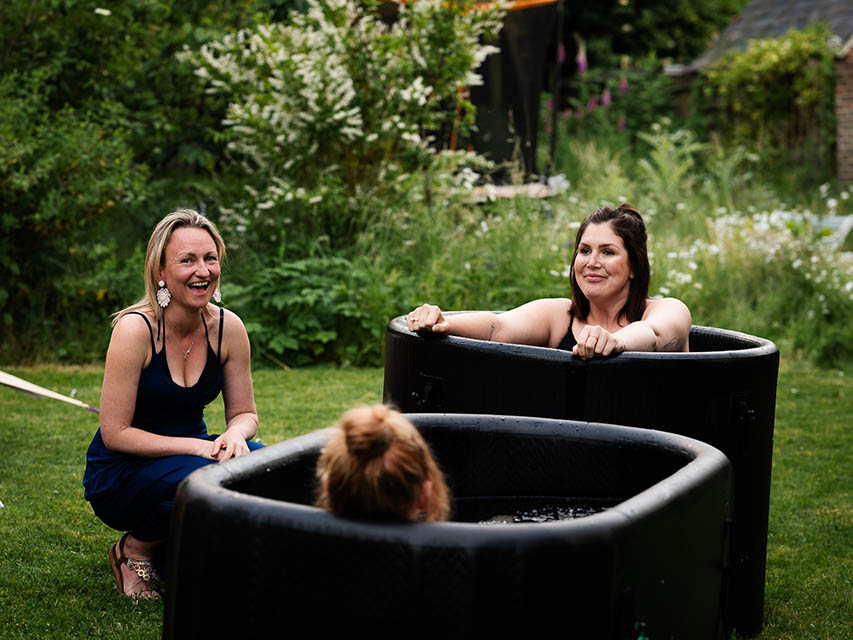
Hello, I’m Charlotte. I am a qualified therapist with a focus on working outdoors. I help people to be seen and heard through Walk & Talk sessions and other therapeutic experiences such as portrait photography and workshops. I know from my own experience that when we are seen and heard by someone who has empathy with us, we are able to truly see our authentic selves. We are also able to develop and strengthen our voice. We find answers to big questions such as, who am I? What do I want? What do I need?
If you are going through something difficult and are looking for an unconventional and liberating way of to explore your feelings and start to heal, do get in touch. There are no silly questions.